
Kleurbeheerinstellingen
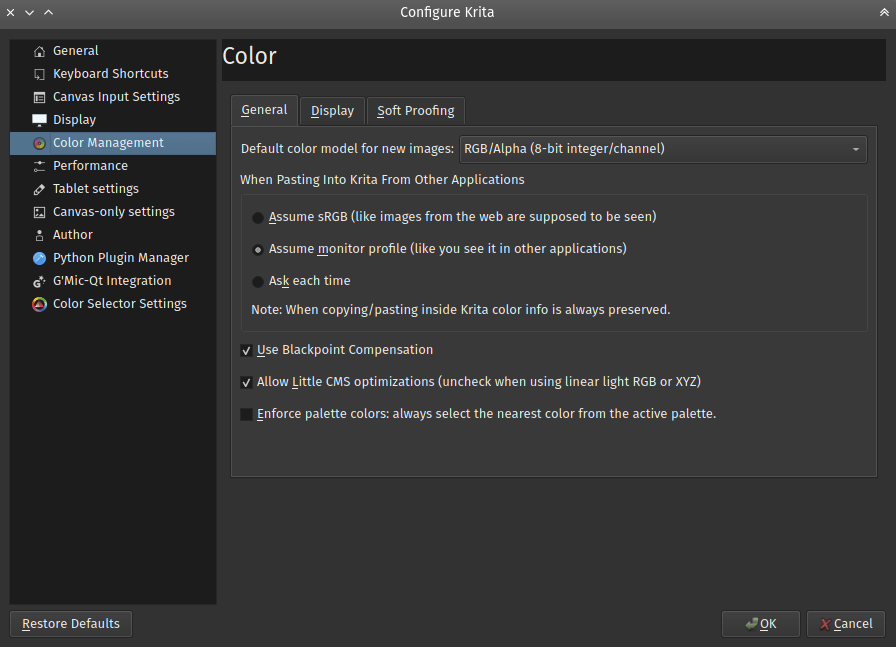
Krita biedt uitgebreide functionaliteit voor het beheer van kleuren, met gebruik van Little CMS We beschrijven Kleurbeheer op een algemener manier hier: Werkmethode kleurbeheer.
Algemeen
Standaard kleurmodel voor nieuwe afbeeldingen
Kies het standaard model dat uw voorkeur heeft voor al uw afbeeldingen.
Bij het plakken naar Krita vanuit andere toepassingen
De gebruiker kan definiëren welk soort conversie, indien een toegepast, Krita zal uitvoeren op een afbeelding die gekopieerd wordt uit een andere toepassing bijv. een webbrowser, GIMP, enz.
- Uitgaan van sRGB
Deze optie zal de geplakte afbeelding tonen in het standaard ICC-profiel van sRGB van Krita.
- Uitgaan van Monitorprofiel
Deze optie zal de geplakte afbeelding tonen in het monitorprofiel zoals ingesteld in de systeeminstellingen.
- Elke keer vragen
Krita het zal iedere keer als een afbeelding is geplakt aan de gebruiker vragen wat er gedaan moet worden. Dit is de standaardinstelling.
Notitie
Bij het kopiëren/plakken binnen Krita wordt de kleureninformatie altijd behouden.
Zwartpuntcompensatie gebruiken
Dit zal voor de conversie de zwartpuntcompensatie inschakelen. BPC wordt door de ontwikkelaar als volgt omschreven:
Kleine CMS optimalisaties toestaan
Schakel dit uit om optimalisaties uit te schakelen. Soms geeft “Kleine CMS optimalisaties” bij het werken met lineaire kleurruimtes niet het beste resultaat.
Veranderd in versie 5.0: Vanaf Krita 5.0, leveren we de fast-float plugin for LittleCMS. Als u dit uitschakelt dan schakelt u ook de fast float plugin uit.
Dwing kleuren uit het palet af: selecteer altijd de dichtstbijzijnde kleur uit het actieve palet
Standaard neemt het palet-selectie de huidige voorgrondkleur, vergelijkt dit met de kleuren in het actieve palet en markeert de kleur die het dichtst bij de huidige voorgrondkleur komt.
Als Dwing kleuren uit het palet af is ingeschakeld, dan schakelt het de interne kleurenkiezer om naar een modus waarbij in plaats van de kleur gewoon te markeren, de huidige voorgrondkleur worden verwisselt met de dichtstbijzijnde kleur.
Beeldscherm
Bij systemen die direct toegang tot het beeldscherm geven
Bij alle platformen behalve native Wayland neemt Krita aan dat het direct toegang heeft tot het beeldscherm. In deze mode hoeft men eigenlijk alleen maar drie eenvoudige opties te selecteren om de kleurenmanagement goed in te stellen.
- Monitorprofiel van systeem gebruiken
Als dit is ingeschakeld dan zal Krita het ICC-profiel gebruiken die in uw systeeminstellingen geselecteerd is.
- Beeldscherm profielen
Er zijn hier net zoveel als dat er beeldschermen aangesloten zijn. U kan een ICC-profiel selecteren die Krita vervolgens zal gebruiken onafhankelijk van het monitorprofiel dat in de systeeminstellingen is geselecteerd. De standaard is
sRGB built-in.Als u geen colorimeter heeft, probeer dan om het profiel te gebruiken dat de fabrikant van uw beeldscherm met uw beeldscherm heeft meegeleverd. Bij goede beeldschermen zijn deze profielen meestal redelijk goed (tenminste bij lineaire kleurverlopen).
Notitie
Als u een Wayland-compatible compositor gebruikt, maar Krita in XWayland mode gebruikt, dan zou u
sRGB built-inals beeldscherm-profiel moeten selecteren, omdat Wayland een venster van Krita ziet als “unmanaged sRGB surface”.Bij Unix systemen, wordt de profielen opgeslagen in $/usr/share/color/icc (systeem locatie) of $~/.local/share/color/icc (locale locatie) zal worden voorgesteld. Profielen opgeslagen in Krita voorkeuren-map, $~/.local/share/krita/profiles zijn alleen zichtbaar in Krita.
- Renderingmethode
Uw keuze voor de renderingmethode is een manier om Littlecms te vertellen hoe u wilt dat de kleuren van een kleurruimte naar een andere kleurruimte worden geconverteerd. Er zijn vier keuzemogelijkheden beschikbaar, ze worden allemaal uitgelegd in de:icc_profiles handleiding.
Bij systemen die Wayland gebruiken
Added in version 6.0.
Notitie
Vanaf Krita 6.0.0, gebruikt Krita standaard niet het Wayland protocol zelfs niet als een Wayland compositor beschikbaar is. Krita geeft de voorkeur aan het oudere XWayland protocol. Om Krita te forceren dat het Wayland protocol gebruikt, moet u het opstarten met variabele QT_QPA_PLATFORM ingesteld:
QT_QPA_PLATFORM=wayland krita
- Renderingmethode
Dit regelt bij Wayland hoe het de kleuren in de afbeelding koppelt met de kleurruimte van het beeldscherm. Als in Wayland compositor het monitorprofiel correct is opgezet, dan kan dit op :guilabel: Relatief colorimetrisch blijven en Zwartpuntcompensatie gebruiken ingeschakeld blijven. Dit zal ervoor zorgen dat de witte en zwarte punten in de afbeelding aangepast worden naar bijbehorende punten van de monitor en de gehele kleurruimte in de monitor zal passen.
Als het beeldscherm-profiel niet correct is ingesteld in de Wayland compositor of er wordt de voorkeur gegeven aan om enkele aangepaste functies voor kleurbijstelling of te gebruiken, dan kan Op waarneming als renderer worden ingesteld. Let er wel op dat de kleuren zoals die op uw scherm worden getoond in dit geval niet colorimetrisch correct zijn! In de Op waarneming mode, is het de compositor toegestaan om uw kleuren in willekeurige manieren aan te passen, b.v. de sRGB ruimte wat ruimer uit te rekken om de kleuren “er beter uit te laten zien” op beeldschermen met een breed kleurenbereik. Daarom kan het renderen met Op waarneming niet geschikt zijn voor kleur-kritisch werk.
- Kleurbeheer van werkveld inschakelen
Deze schakelaar is alleen aanwezig voor debugging. Indien niet geselecteerd, zal Krita’s werkvlak stoppen met het gebruik van een aparte native oppervlak met breed kleurenbereik voor het renderen van de afbeelding. In plaats daarvan zal het het hoofd sRGB oppervlak van het programma gebruiken. Dit houd in dat het werkvlak in wezen omschakelt naar de sRGB mode.
- Kleurruimte van oppervlak van werkveld
Selecteert de kleurruimte waarin de afbeelding naar de compositor wordt gestuurd.
- Voorkeur door besturingssysteem
De afbeelding zal naar de compositor worden verstuurd in de indeling waaraan de compositor zelf de voorkeur aangeeft. In de meeste gevallen zal dit de meest efficiënte manier van communicatie zijn tussen Krita en de compositor.
De exacte indeling waaraan de compositor de voorkeur aan geeft is onderaan de pagina te zien.
Gebruik deze instelling tenzij u redenen heeft om het niet te doen.
- Rec 709 Gamma 2.2
Dit is een SDR kleurruimte waarbij de primaire kleuren gelijk zijn aan sRGB en de overzet-functie op “gamma 2.2” is ingesteld.
- Rec 709 Linear
Dit is een SDR kleurruimte waarbij de primaire kleuren gelijk zijn aan sRGB met een lineaire overzet-functie. Tenzij uw systeem met een 16-bit floating point oppervlak bitdiepte overweg kan, kan u beter deze optie alleen voor debugging gebruiken.
- Rec 2020 PQ
Dit is een HDR kleurruimte zoals gedefinieerd in de Rec. 2100 specificatie. Dit is de enige kleurruimte waarmee HDR data door Krita aan de compositor overgedragen kan worden!
Notitie
In de huidige implementatie van de HDR conversie in Krita, is het diffuse wit van deze HDR kleurruimte altijd vastgezet op 80 cd/m². Met andere woorden, als u een afbeelding heeft met een scènegebonden lineaire ruimte (b.v. ACEScg), het converteert naar Rec 2020 PQ, dan zal de RGB kleurwaarde
(1.0, 1.0, 1.0)van deze afbeelding overgezet worden naar 80 cd/m² value in het PQ-bereik.Als “Rec 2020 PQ”-data door Krita aan de compositor overdraagt, dan zal het correct deze diffuse wit punt aan de compositor declareren. De compositor, op zijn beurt, past een extra curve toe op de afbeelding om dit niveau aan te passen aan de door de gebruiker ingestelde”SDR helderheidsniveau” in het systeem-brede HDR configuratie pagina.
- Onbeheerd (alleen testen)
Deze optie schakelt elke kleurruimte uit op het werkvlak. Dit laat de compositor met de kleuren doen wat het wil.
- Bitdiepte van werkveldoppervlakte (heeft opnieuw starten nodig)
Selecteert de bitdieptes van het werkvlak. Vanwege beperkingen van Qt, moeten de bitdiepte van alle oppervlakken in het programma hetzelfde zijn, daarom vereist het wijzigen van de waarde dat heel Krita opnieuw opgestart wordt.
- Huidige bitdiepte van werkveldoppervlakte
De bitdiepte die op dit moment gebruikt wordt voor het werkveldoppervlakte. De bitdiepte voor het werkveldoppervlakte wordt geselecteerd bij het opstarten van Krita, en zal niet veranderen tijdens de tijd dat Krita in werking is.
- Kleurruimte van voorkeur door besturingssysteem
Toont informatie over de kleurruimte waaraan door de compositor de voorkeur aan wordt gegeven. Deze kleurruimte zal worden gebruikt als de Voorkeur door besturingssysteem kleurruimte is geselecteerd.
Deze data kan laten zien of de compositor op dit moment met de HDR mode werkt. Controleer de waarde van
Kleurruimte >Lichtkracht.AlsLichtkrachtgroter is danreferentie Lichtkracht, dan is de HDR mode van de compositor ingeschakeld.
Soft-proofing
Hier kunt u de standaard softproofing instellingen instellen. Om de werkelijk softproofing van de huidige afbeelding in te stellen, gaat u naar .
Voor een gedetailleerde uitleg over hoe u softproofing gebruikt, leest u de pagina over softproofing.