
Ustawienia zarządzania kolorem
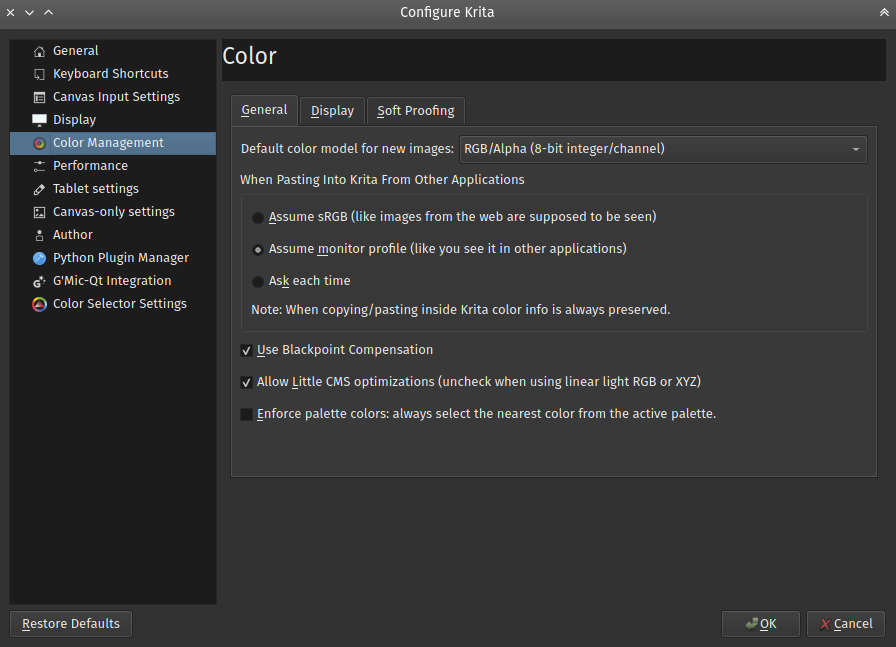
Krita daje zaawansowane możliwości do zarządzania barwami, wykorzystując Little CMS Zarządzanie barwami opisujemy w szczegółach tutaj: Praca z zarządzaniem barwami.
Ogólne
Domyślny model barwy dla nowych obrazów
Wybierz model używany dla wszystkich swoich obrazów.
Podczas wklejania do Krity z innych programów
Użytkownik określa jaki rodzaj przekształcenia, jeśli jakikolwiek, Krita będzie wykonywać na obrazie, który będzie skopiowany z innych aplikacji, takich jak przeglądarka, GIMP, itp.
- Przyjmij sRGB
To ustawienie pokaże wklejony obraz w domyślnym profilu ICC Krity będącym sRGB.
- Przyjmij profil monitora
To ustawienie pokaże wklejony obraz w profilu monitora wybranym w ustawieniach systemowych.
- Pytaj za każdym razem
Krita zapyta użytkownika za każdym razem, gdy obraz będzie wklejany, o to co z nim zrobić. Jest to domyślne ustawienie.
Informacja
Przy kopiowaniu w wklejaniu w Kricie, dane o barwie są zawsze zachowywane.
Użyj kompensacji punktu czerni
To ustawienie włączy kompensacji punktu czerni (BPC) dla przekształceń. Ustawienie to jest opisane przez opiekuna LCMS jak następuje:
Zezwól na optymalizacje LittleCMS
Odznacz to pole, aby wyłączyć optymalizacje. Czasami, w przypadku pracy z liniowymi przestrzeniami barw, optymalizacje takie jak Little CMS nie dadzą najlepszych wyników.
Zmienione w wersji 5.0: Od czasu Krity 5.0, dostarczamy wtyczkę szybkich liczb rzeczywistych dla LittleCMS. Odznaczenie tego pola wyłączy tę wtyczkę.
Wymuszanie barwy palety: zawsze zaznaczaj najbliższą barwę z używanej palety
Domyślnie, wybieraki palet biorą bieżącą barwę drugoplanową, porównują ją z łatkami w bieżącej palecie i podświetlają łatkę, która jest najbliżej bieżącej barwy pierwszoplanowej.
Gdy zaznaczone jest ustawienie Wymuś barwy palety, to następuje przełączenie z wewnętrznego wybieraka barw do trybu, w którym, zamiast tylko podświetlać łatkę, bieżąca barwa pierwszoplanowa jest zastępowana barwą najbliższej łatki.
Wyświetlacz
On systems providing direct access to the display
On all the platforms except native Wayland Krita assumes that it has direct access to the screen. In this mode, you can basically need to select three simple options to set display color management right.
- Użyj profilu monitora systemowego
To ustawienie powie Kricie, aby używała profilu ICC wybranego w ustawieniach systemowych.
- Display Profiles
There are as many of these as you have displays connected. You can select an ICC profile which Krita will use independent of the monitor profile set in system preferences. The default is
sRGB built-in.If you don’t have a hardware colorimeter device, try using the profile shipped by the manufacturer of your display with your display. For good displays, these profiles are usually decently good (at least in linearizing gradients).
Informacja
If you use Wayland-compatible compositor, but run Krita in XWayland mode, then you should select
sRGB built-inas the display profile, since Wayland will treat Krita’s window as „unmanaged sRGB surface”.On Unix systems, profile stored in $/usr/share/color/icc (system location) or $~/.local/share/color/icc (local location) will be proposed. Profile stored in Krita preference folder, $~/.local/share/krita/profiles will be visible only in Krita.
- Zamiar renderingu
Twój zamiar renderingu jest sposobem na powiedzenie LittleCMS w jaki sposób chcesz, aby barwy z jednej przestrzeni barw były zmapowane do innej. Dostępne są cztery ustawienia, wszystkie zostały wyjaśnione na stronie podręcznika Profile ICC.
On systems using Wayland
Added in version 6.0.
Informacja
As of Krita 6.0.0, by default, Krita does not use Wayland protocol even when a Wayland
compositor is available. Krita prefers legacy XWayland protocol. To force Krita use native
Wayland protocol, run it with QT_QPA_PLATFORM environment set:
QT_QPA_PLATFORM=wayland krita
- Zamiar renderingu
This option instructs Wayland on how it should map the image colors into the display color space. If you have display profile set up properly in Wayland compositor itself, then you should keep this value set to Relative Colorimetric and have Use Blackpoint Compensation option enabled. It will ensure that white and black points of your image will be adjusted to the corresponding points of your display and the entire color volume will be scaled to fit your display space.
If you don’t have the display profile set up properly in Wayland compositor or you would like to use some custom color adjustment features of your compositor, then you can set Perceptual as your intent. Beware though, the colors rendered on your screen may not be colorimetrically correct in this case! In Perceptual mode, the compositor is allowed to change your colors in arbitrary ways, e.g. stretch sRGB space into something wider to make colors „look better” on wide gamut displays. So Perceptual intent may be not suitable for color critical work.
- Enable canvas color management
This switch is present for debugging purposes only. When unchecked, Krita’s canvas stops using a separate wide-gamut native surface for image rendering. Instead, it reused the main sRGB surface of the application. It means that the canvas effectively switches into sRGB mode.
- Canvas surface color space
Selects the color space in which the image data is sent to the compositor.
- Preferred by operating system
The image data will be sent to the compositor in the format preferred by the compositor itself. In most of the cases it will be the most efficient way of communication between Krita and the compositor.
The exact format preferred by the compositor can be seen at the bottom of the page.
Use this option unless you have reasons not to.
- Rec 709 Gamma 2.2
This is an SDR color space with color primaries equal to sRGB and transfer function set to „gamma 2.2”.
- Rec 709 Linear
This is an SDR color space with color primaries equal to sRGB and a linear transfer function. Unless your system supports 16-bit floating point surface bit depth, use this option for debugging purposes only.
- Rec 2020 PQ
This is an HDR color space as defined by Rec. 2100 specification. This is the only color space in which Krita can pass HDR data to the compositor!
Informacja
In the current implementation of HDR conversions in Krita, the diffuse white of this HDR color space is always fixed to 80 cd/m². In other words, if you take an image in a scene-referred linear space (e.g. ACEScg), convert it into Rec 2020 PQ, then RGB color value
(1.0, 1.0, 1.0)of this image will be mapped to 80 cd/m² value in the PQ-range.When Krita passes „Rec 2020 PQ”-data to the compositor, it correctly declares this diffuse white point to the compositor. The compositor, in turn, applies an additional curve to the image to adapt this level to the „SDR brightness level” selected by the user in the system-wide HDR configuration page.
- Unmanaged (testing only)
This option disables setting any color space metadata on the canvas» surface. This basically lets the compositor do with the colors whatever it prefers.
- Canvas surface bit depth (needs restart)
Selects bit depth of the canvas surface. Due to limitations in Qt, the bit depth of all the surfaces in the application should be the same, hence changing the value requires full Krita restart.
- Current canvas surface bit depth
The currently used bit depth for the canvas surface. The bit depth of the canvas is selected on Krita start up, and will not change while Krita is running.
- Color space preferred by the operating system
Shows information about the color space preferred by the compositor. This space will be used when Preferred by operating system color space is selected.
This data can show if your compositor currently works in HDR mode. Check the value of
Color Space->Luminance. IfmaxLuminanceis higher thanreferenceLuminance, then your compositor has HDR mode enabled.
Ustawienia softproofing
To umożliwia ci ustawienie domyślnych ustawień softproofing. Aby ustawić softproofing dla bieżącego obrazu, przejdź do .
Po szczegóły nt. tego jak używać softproofing, zajrzyj na stronę o softproofing.