
色彩管理设置
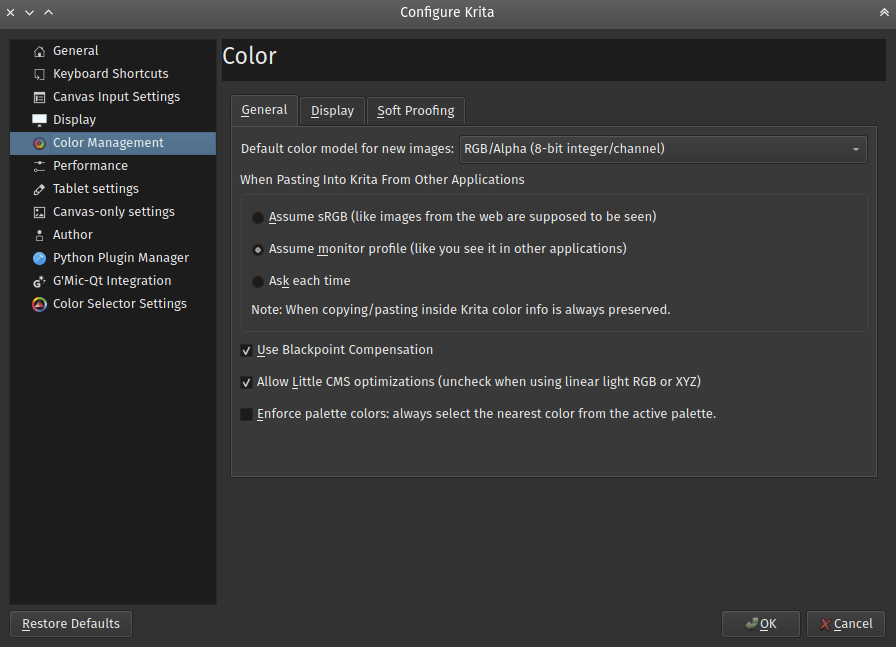
Krita 内建了功能完整的色彩管理功能,其中 ICC 支持是通过 Little CMS 软件库实现的。具体的色彩管理流程请参见 色彩管理流程 页面。
常规标签页
新建图像默认色彩模型
选择新建图像的默认色彩模型。
从其他程序复制/粘贴图像至 Krita 时,假设图像色彩空间为
选择在从其他程序 (浏览器、GIMP 等) 复制的图像被粘贴进 Krita 时应如何处理其色彩空间。
- 标准 sRGB 空间
选中此项,则自动假定粘贴的图像使用 Krita 默认的 sRGB 色彩配置文件。这也是业界通行的网络图像标准。
- 当前显示器空间
选中此项,将使用本机的显示器特性文件解析图像色彩空间。此选项只面向熟悉色彩管理的人员。
- 每次询问
这是默认选项。Krita 将在每次粘贴图像时询问用户如何处理。
备注
在 Krita 内部复制/粘贴图像时,图像的色彩空间信息将始终保留。
使用黑点补偿
勾选此项,则在进行色彩转换时使用黑点补偿 (BPC)。LittleCMS (Krita 的色彩管理软件库) 的主程序员是这样解释黑点补偿的:
允许 LittleCMS 优化
取消勾选此项即可关闭 LittleCMS 优化。在某些场合,如使用线性色彩空间时,LittleCMS 优化会造成问题,因此需要关闭它。
在 5.0 版本发生变更: 从 Krita 5.0 起,软件自带了 LittleCMS 快速浮点插件 以提高色彩管理性能。关闭 LittleCMS 优化也将关闭这款插件。
强制拾取色板颜色
默认状态下 (不勾选),色板面板会自动高亮显示与前景色最接近的色板颜色。
勾选此项,则在拾取颜色时,新前景色将直接被替换为与拾取颜色最接近的色板颜色。
显示标签页
系统允许直接访问显示器信息的环境
在除原生 Wayland 之外的所有平台上,Krita 会假定其可直接访问屏幕信息。在此模式下,您基本上只需配置三个简单选项即可对显示器进行色彩管理。
- 使用系统显示器特性文件
勾选此项,Krita 将使用本机系统设置中指定的 ICC 色彩特性文件来对显示的色彩进行色彩管理。
- 显示器特性文件
每台连接的显示器对应一个特性文件,可以使用独立于来自系统配置的显示器特性文件。默认值是
sRGB built-in(Krita 自带的标准 sRGB 特性文件)。要正确进行色彩管理,理想的做法是使用硬件校色仪生成显示器的色彩特性文件。如果没有校色仪,也可以尝试使用显示器厂商提供的特性文件。对于高端显示器,厂商提供的特性文件一般不会太离谱,起码能减轻渐变过渡中的色带和偏色现象。
备注
如果您使用的是兼容 Wayland 的显示合成器,但在 XWayland 模式下运行 Krita,则应选择
sRGB built-in作为显示器特性文件,因为 Wayland 会将 Krita 的窗口作为“不进行色彩管理的 sRGB 表面”进行处理。在类 Unix 系统上,系统和 Krita 将自动识别以下位置中的色彩特性文件:$/usr/share/color/icc (系统特性文件) 或 $~/.local/share/color/icc (用户特性文件)。Krita 的配置文件夹中也有存储特性文件的位置:$~/.local/share/krita/profiles,它们只能被 Krita 识别。
- 渲染意图
选择 LittleCMS 在不同色彩空间之间进行转换的方式,一共有 4 种。请在 ICC 特性文件页面进一步了解它们的工作特性。
Wayland 环境
Added in version 6.0.
备注
到 Krita 6.0.0 版为止,即使 Wayland 显示合成器可用,Krita 在默认情况下也不会使用 Wayland 协议,而是优先使用 XWayland 协议。要强制 Krita 使用原生 Wayland 协议,请使用 QT_QPA_PLATFORM 环境设置运行它。
QT_QPA_PLATFORM=wayland krita
- 渲染意图
此选项指示 Wayland 应该如何将图像的色彩空间映射到显示器的色彩空间。如果您已经在 Wayland 显示合成器中正确设置了显示器的特性文件,您应该将此值设为 相对色度 并启用 使用黑点补偿 。这将确保图像的黑点和白点被调整为显示器色彩空间中对应的位置,且整个色彩空间将缩放以适应显示器的空间。
如果您没有在 Wayland 显示合成器中正确设置显示器的特性文件,或者您想要使用显示合成器的某些颜色调整特性,那么请将渲染意图设为 感知 。不过请注意,在这种情况下,屏幕上呈现的颜色的色度可能会不准确。 感知 模式允许显示合成器以任意方式调整显示的颜色,例如将 sRGB 空间拉伸到更宽的空间中,使得颜色在宽色域显示器上看起来更加鲜艳。因此, 感知 模式可能不适合对色彩精度有严格要求的场合。
- 启用画布色彩管理
此开关仅用于调试目的。当未选中时,Krita 的画布将停止使用单独的宽色域原生表面进行图像渲染。相反,它会对应用程序的主 sRGB 表面进行复用。这意味着画布实际上切换到了 sRGB 模式。
- 画布表面色彩空间
选择图像数据发送到显示合成器时使用的色彩空间。
- 操作系统首选色彩空间
图像数据将以显示合成器偏好的格式发送给它。在大多数情况下,这将是 Krita 与显示合成器之间最高效的通信方式。
显示合成器所偏好的确切格式显示在该配置页面底部。
如果没有特殊的理由,建议使用此项。
- Rec 709 Gamma 2.2
这是一个 SDR 色彩空间,其原色与 sRGB 相同,传递函数设置为 gamma 2.2。
- Rec 709 Linear
这是一个 SDR 色彩空间,其原色与 sRGB 相同,并采用线性传递函数。除非您的系统支持 16 位浮点表面位深度,否则请仅将此选项用于调试目的。
- Rec 2020 PQ
这是由 Rec. 2100 规范定义的 HDR 色彩空间,也是 Krita 能够将 HDR 数据传递给显示合成器的唯一色彩空间。
备注
在 Krita 当前的 HDR 转换实现中,此 HDR 色彩空间的 漫反射白点 始终固定为 80 cd/m²。换句话说,如果您将处于场景参考线性空间 (例如 ACEScg) 中的图像转换为 Rec 2020 PQ,那么此图像的 RGB 颜色值
(1.0, 1.0, 1.0)将被映射到 PQ 范围内的 80 cd/m²值。当 Krita 将 Rec 2020 PQ 格式的图像数据传输给显示合成器时,它会按照规定向合成器声明上述的 漫反射白点 。反过来,显示合成器则会对图像应用一条额外的曲线,以将此亮度级别调整为用户在系统全局 HDR 配置页面中选择的 SDR 亮度级别。
- 不进行色彩管理 (仅用于测试)
此选项会禁用在画布表面设置任何色彩空间元数据。这实际上会让显示合成器自行决定如何处理颜色。
- 画布表面位深度 (需要重启)
选择画布表面的色彩位深度。由于 Qt 的限制,应用程序中所有表面的位深度必须一致,因此更改此设置后需要重启 Krita。
- 当前画布表面位深度
当前画布表面所使用的色彩位深度。画布的位深度在 Krita 启动时选定,在 Krita 运行期间不会改变。
- 操作系统首选色彩空间
显示合成器所偏好的色彩空间的信息。选中 操作系统首选色彩空间 时将使用此空间。
此数据可反映您的显示合成器当前是否处于 HDR 模式。请检查
色彩空间 -> 亮度的值,如果最大亮度高于参考亮度,则表示的显示合成器已启用 HDR 模式。
色彩校样标签页
此标签页配置的是 默认 的色彩校样选项。要调整当前图像的色彩校样选项,请前往菜单栏的 标签页进行配置。
关于如何进行色彩校样的详细介绍,请参见色彩校样页面的说明。