
Remplissage de motifs
Ceci remplit le calque avec une forme ou une texture prédéfinie chargée dans Krita grâce à l'interface de gestion des ressources. Les motifs peuvent être une façon simple et intéressante d'ajouter une texture à votre dessin ou peinture, vous aidant à re-créer l'apparence du papier d'aquarelle, du lin, de la tapisserie, de l'aggloméré, de la roche ou une infinité d'autres options. Par exemple, si vous voulez faire une peinture numérique et la terminer avec une apparence de canevas, vous pouvez ajouter une texture de canevas avec « Remplir le calque » à partir du paquet de texture ci-dessous et définir l'opacité à un niveau très bas. Ainsi, les « traitements » de la forme sont à peine visibles. L'effet est tout à fait convaincant.
Vous pouvez créer les vôtres et les utiliser. Pour un grand ensemble de profils bien conçus et utiles, veuillez consulter l'un de vos artistes favoris et un grand ami de Krita, David Revoy, avec son paquet de texture libre (https://www.davidrevoy.com/article156/texture-pack-1).
- Transformer
Ajouté dans la version 4.4.
Ceci permet de définir un certain nombre d'options de transformation sur le motif, comme le re-dimensionnement ou la rotation.
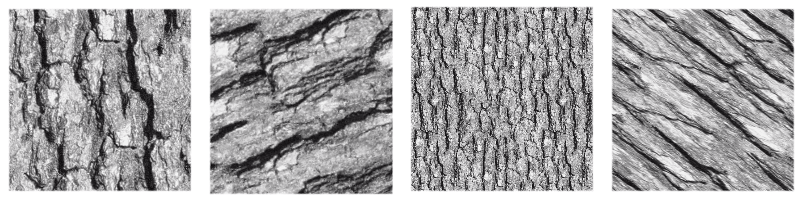
Les images affichant plus transformation appliquées à une texture unique.
- Align to pixel grid
Ajouté dans la version 5.3.
When a geometric transformation is applied to a pattern, the corners of the repeated image may be displaced to any new position, including fractional coordinates (sub-pixel, non integer coordinates). This is the default behavior and it is fine most of the times. But there are times when it is desirable that the corners end up at integer coordinates. For example when exact repeatability with pixel accuracy is needed. This can be achieved by checking the align to pixel grid option. By doing so, the pattern corners are ensured to fall at integer coordinates after the transformation.
Keep in mind that this alignment reduces the number of possible transformations (in fact, all those transformations that map the corners to fractional coordinates are removed), but the aligned transformation will approximate the un-aligned one as close as possible. There is also the possibility of setting this alignment over a number of repetitions of the pattern the corners should be aligned.
This option is especially useful when dealing with small patterns, for example those used for screentones, or when the pattern is scaled down to be really small, since it helps reducing some artifacts like moiré patterns.
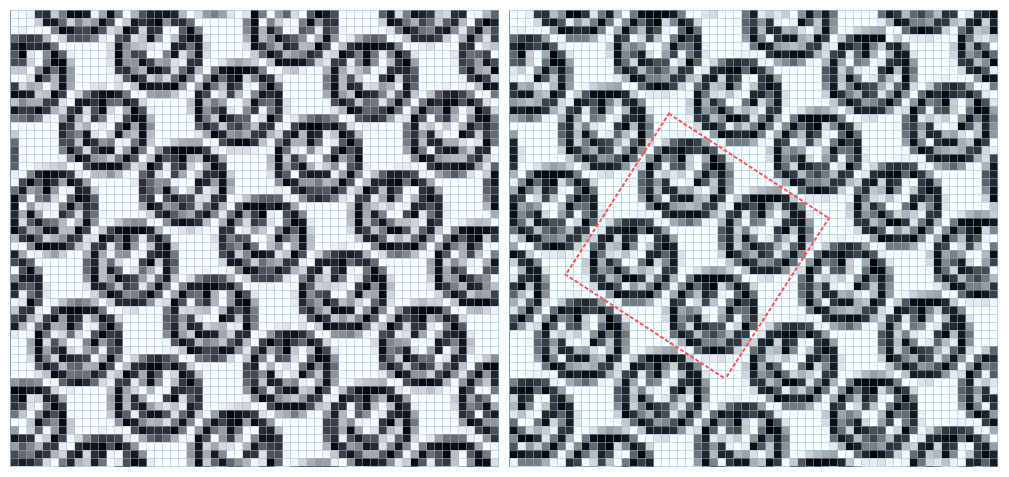
This image shows a pattern fill layer that uses a smiley face image. It is being transformed by scaling to 75% and rotating 34 degrees. On the left no alignment is being applied and on the right the alignment is active and set to every two repetitions, both horizontally and vertically. The blue lines are indicators of the pixel grid and the red ones mark a block of two by two repetitions whose corners are aligned to the pixel grid. Note that, when the alignment is on, then that block is repeated exactly through the image, but when it is off, every instance of the pattern is rendered slightly different.